
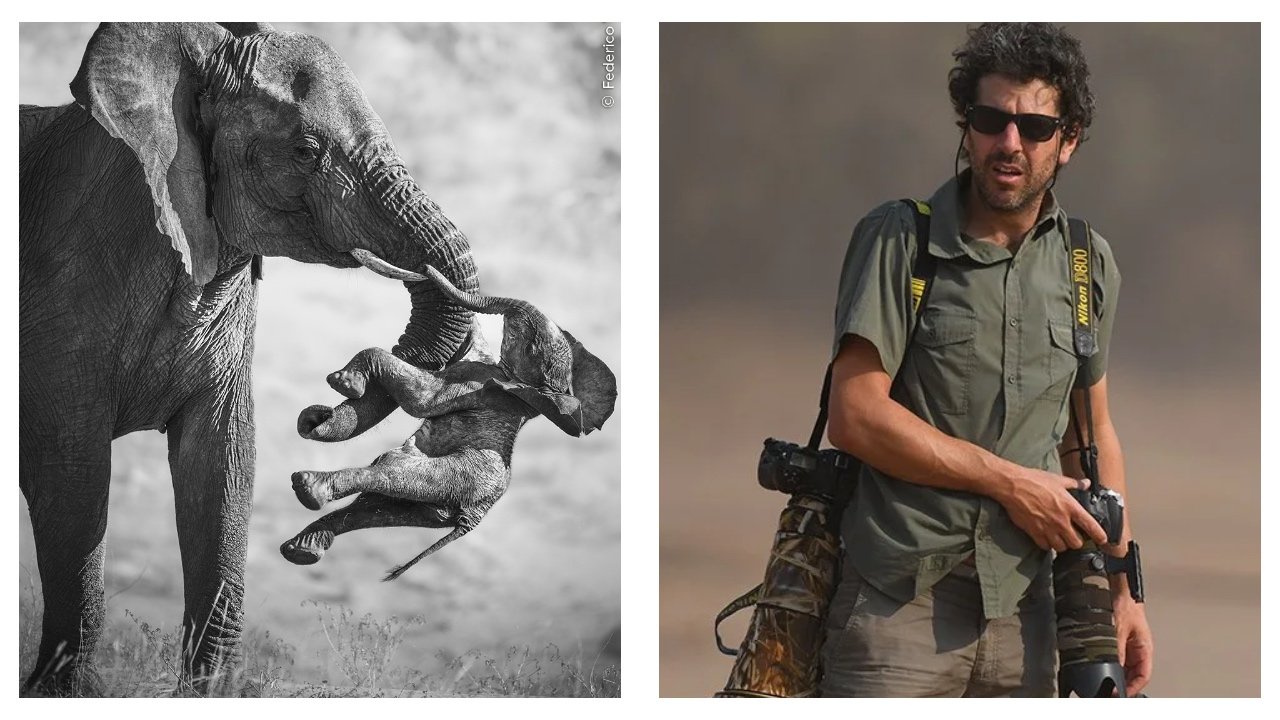
The Natural History Museum has sealed its Wildlife Photographer of the Year competition with “The Aftermath” by Italian photographer Federico Veronesi as the winner of this year’s edition, citing his monochromatic capture of an elephant carrying a deceased calf.
As shared by Veronesi, he stumbled upon the scene while he was tracking elephants in Namibia’s Huab River Valley.
His initial thought on the drag marks he was trailing was a path from a dragged log of a bull elephant.
But the marks ended at a herd where a female elephant was carrying a dead calf with its leg wedged between her trunk and tusk.
A chance encounter in the Huab River Valley
Veronesi said his brief hesitation to capture a private moment gave him time to understand and interpret the scene as “a deep and fascinating window into the soul” of the animals, prompting him to finally click his camera.
The photograph was hailed by the judges as a piece that conveys a challenging but impactful insight into complex animal behaviour.
It also won the Behaviour: Mammals category.
A record field and a first for black-and-white photography
The 2026 edition of the competition drew a record-breaking entry of 65,403 from 121 countries and territories.
Furthermore, it is the first in 62 years to name black-and-white photographs as winners of both the adult and young main titles.
Young British photographer Oscar Whitfield from Zimbabwe took home the Young Wildlife Photographer of the Year/11-14 Years.
His award-winning image, “Labour of Love,” was captured after a beetle passed his lens while he was lying flat on the ground.
Other winners
Other winners cited in a BBC report include:
Young categories
10 Years and Under: “Flight of the Bumblebee,” Amelie Davis (United Kingdom)
15-17 Years: “Birdsong Painted in Light,” Konrad Gräeter (Germany).
Behaviour
Birds: “Scenes from the Swamp,” Isak Pretorius (South Africa).
Amphibians and Reptiles: “Protective Pose,” Anton Sorokin (USA).
Invertebrates: “Shifting Sand,” Sitaram Raul (India)
Portraits, environment and habitat
Animals in their Environment: “The Meeting Place,” James Lewin (United Kingdom).
Animal Portraits: “A Watchful Eye,” Aaron Sanders (United Kingdom).
Oceans: The Bigger Picture: “Night-Time Catch,” Alex Lindbloom (USA).
Wetlands: The Bigger Picture: “The Great Divide,” Alex Visbal (Colombia).
Underwater: “Making Morays,” Tony Wu (Japan/USA).
Urban Wildlife: “Urban Jungle,” Seth Forestson (USA).
Plants and art
Plants and Fungi: “Shedding Light,” Agorastos Papatsanis (Greece).
Natural Artistry: “Escape Artistry,” Michał Michalski (Poland).
Photojournalism and special awards
Photojournalism: “Warning Sign,” Francisco Negroni (Chile).
Photojournalist Story Award: “Wily Coyotes of San Francisco,” Loren Elliott (USA).
Rising Star Award: “Hidden Depths,” Alexis Tinker-Tsavalas (Germany).
Portfolio Award: “Secret World,” Kutub Uddin (Bangladesh/United Kingdom).

From a magazine contest to a global showcase
The BBC Wildlife Magazine founded the competition in 1965 under its then name, Animals.
Its first edition drew just 361 entries, and its winner, C V R Dowdeswell, received his award from David Attenborough.
The Natural History Museum joined forces with the magazine in 1984 to create the competition as it is known today, and it is now run and owned solely by the museum.
Judgement on the entries submitted by both professionals and amateurs has always been anonymous to preserve a fair evaluation and vote.
The winning photographs will be exhibited at the Natural History Museum in London from Friday, October 16, 2026 until Sunday, July 11, 2027.
Additionally, October 14 marks the publishing of the companion book, “Wildlife Photographer of the Year Portfolio 36.”
READ NEXT: Vietnam’s largest coffee festival set for March 2027