
The ATP season has entered its second indoor phase. Basel and Vienna are hosting 500-level events before the final Masters competition in Paris.
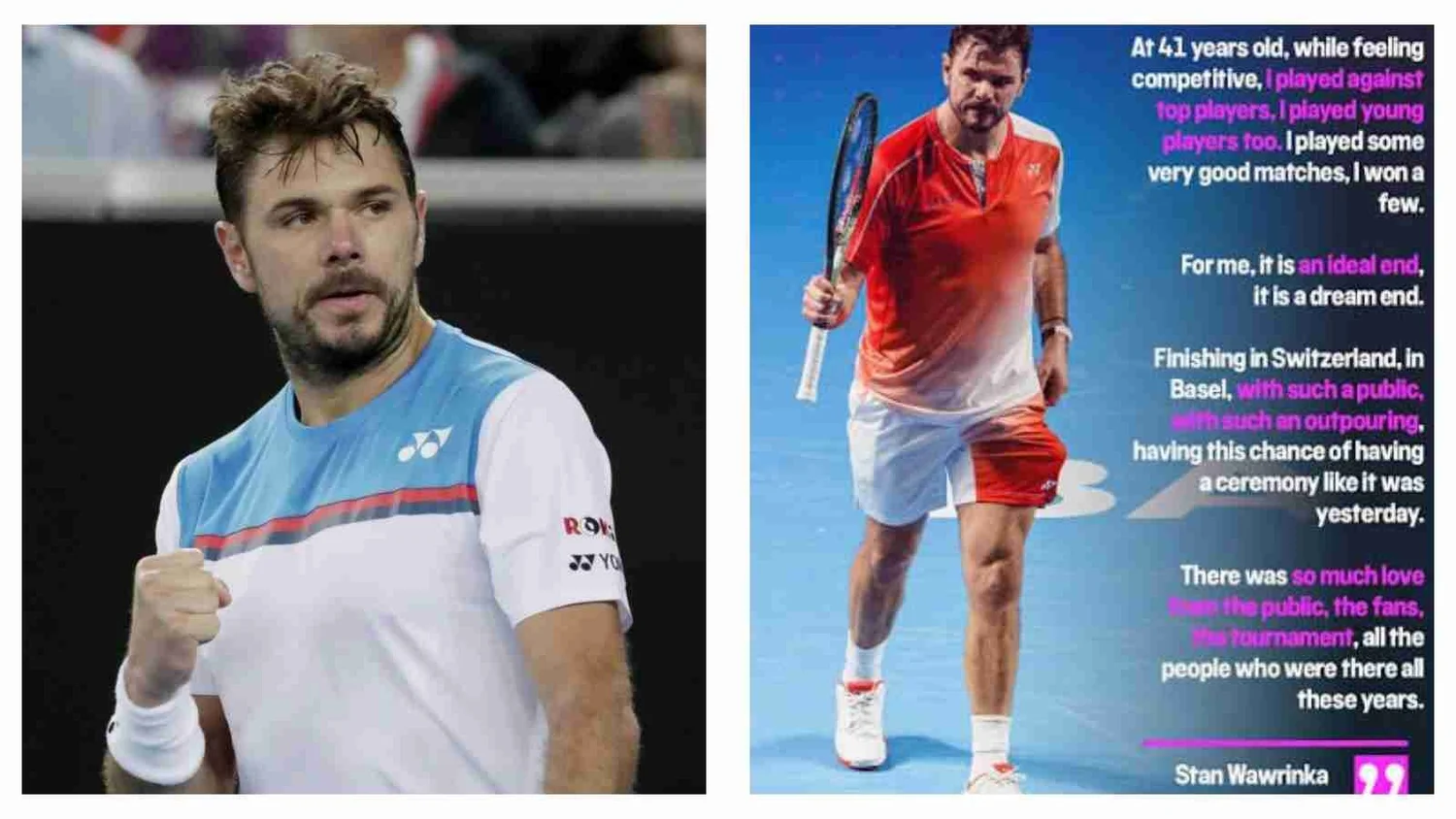
At the Swiss tournament, Stan Wawrinka played the 985th and final match of his extraordinary career. His journey began in 2003 and brought him three Grand Slam titles.
Here, Sports News Blitz writer and tennis fan AJ Becker looks back at Wawrinka’s achievements. He also considers the legacy that the much-loved Swiss star may leave behind.
Starting out
It was the summer of 2003. Saddam Hussein had just lost power.
David Beckham had left Manchester United to join Real Madrid.
Meanwhile, a song about Kentucky Fried Chicken and Pizza Hut almost topped the UK charts. Its lyrics offered little in the way of lyrical depth.
Europe was also experiencing an intense heatwave. During that summer, Wawrinka had just won the Junior French Open.
He then began his senior tour career on the home clay of Gstaad.
Early promise
Reaching the boys’ final at Roland Garros does not guarantee future success. For every Andrey Rublev, there is an Uladzimir Ignatik. Similarly, for every Gaël Monfils, there is a Daniel Berta.
However, Wawrinka showed genuine promise during his early years.
His one-handed backhand became his main attacking weapon. It worked particularly well alongside his powerful first serve.
Between 2005 and 2012, Wawrinka rarely moved beyond the level of a solid player. His best Grand Slam performances ended in quarter-final defeats. Meanwhile, the Top 20 appeared to represent his ranking ceiling.
He had enough quality to overpower most players outside the elite group. However, he lacked the killer instinct to consistently challenge the “big four”.
Statement of intent
The term “big four” refers to Roger Federer, Rafael Nadal, Novak Djokovic and Andy Murray. All four players were born within four years of Stan.
Wawrinka lost six of his first seven tour finals. Four of those defeats came against members of the group. Nevertheless, he produced several creditable performances, even if they ultimately ended in defeat.
A casual observer might have expected him to spend his career in their shadow. The “big four” appeared to block his path to major titles.
However, a key decision changed his career. Wawrinka began working with former world number two Magnus Norman at the start of 2013.
That partnership proved career-defining. Wawrinka built his success on court, while Norman helped shape the plan behind it.
The collaboration produced early results. At the Australian Open, Stan came close to defeating Djokovic. He eventually lost 12-10 in the deciding set of a five-hour thriller.
Later, Wawrinka reached his first Masters final in five years in Madrid. It felt like another statement of intent. Even greater achievements, however, still lay ahead.
Grand Slam breakthrough
The following year, fate had a Djokovic rematch in store at the Melbourne major – the Serb by this time having accumulated a 25-match winning streak at the tournament.
Through a combination of tactical boldness – his power from both backhand and forehand wings was rewarded – and mental fortitude – believing he could win in a match others would ‘lose’ before they stepped on the court – it was Wawrinka who emerged on the winning side of an epic this time.
That said, few gave the Swiss a chance in his maiden slam final, having lost all 12 previous encounters (and all 26 sets) against Nadal.
Yet with the application of focus, concentration and steel – along with some truly breathtaking backhand winners – Stan brought the trophy home, elevating himself to a perch unfamiliar to most players in doing so.
Big match mentality
The aforementioned “big four” made successive generations of supposedly high-quality players appear deficient and even poltroon.
Indeed, Wawrinka’s combined record against the “big three” (Federer, Nadal and Djokovic) stands at 12-63.
Nonetheless, Grand Slam events lent a fascinating sub-plot to his rivalries with them; all three of his triumphs involved victory over the then-world #1 in the final.
To achieve the above even once would arguably cross the boundaries of greatness, and Stan is in good company, as only he and Murray won multiple majors in the era of “big three” dominance (2003-2023).
Wawrinka comes across as modest and unassuming, even limelight-allergic, though he will be energised by the glowing tributes paid in recent days, as the hours and days of retirement stretch out before him.
Those behemoth successes have outweighed the occasional disappointment – being unable to make any kind of impact on grass, nor build on his sole Masters success at Monte-Carlo – in a career that has defied the odds.
Legacy
What might the Wawrinka legacy be?
The influence exerted upon younger players with one-handed backhands?
Lorenzo Musetti is heading that league table and has expressed his admiration for Stan, though the Italian is one of just five such players in the current Top 100.
The spirit induced in an underdog facing a daunting final?
They too can believe an against-the-odds victory could be theirs.
The hope bestowed upon underachieving players in their 20s?
They can hit back at the critics with what may be known as The Wawrinka Defence – “he was a late bloomer, I may be also”.
The inspiration placed in a new generation of Swiss talent?
2027 will be the first year this century that neither he nor Federer will have a tour presence; the likes of Jerome Kym and Leandro Riedi have much to live up to.
One hopes the Wawrinka legacy will be all of the above.